Home/Blog

News & education

Equine Lameness

Lameness Part III: How Your Farrier Can Help

Sinking Soles: Understanding Negative Plantar Angles in Equine Hooves

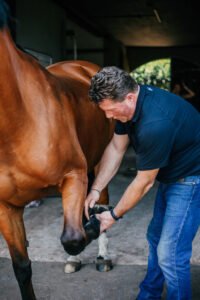
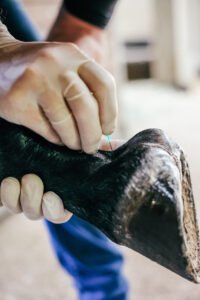
Hoof balance is a cornerstone of equine podiatry, vital for the overall health and soundness of horses. Central to this concept is the alignment of the pedal bone (P3 )within the hoof capsule. When discussing hoof balance, terms like negative plantar angles (NPA) come into play, reflecting a crucial aspect of hoof balance and its […]
Read article
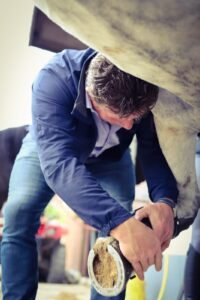
Dr. Henk Offereins examining a horse’s lower limb

A vet who is changing the game

In the ever-evolving world of veterinary medicine, one Irish vet has put himself ahead of the game, innovating his clinical services and extending the remote capabilities of his practice. Henk Offereins is a specialised performance vet, supporting many well-known trainers, owners and sport horse teams worldwide. Recognising an opportunity to do more for his equine […]

Read article
Stem Cells or PRP for Equine Tendon and Ligament Injuries?

Stem Cells or PRP for Equine Tendon and Ligament Injuries?

In recent years, there’s been tremendous interest in using regenerative therapies (or, more accurately, orthobiologics) such as platelet-rich plasma (PRP) and mesenchymal stem cells (MSC) to treat tendon and ligament injuries in horses. The evidence behind their efficacy, however, is slim. So during the 2021 British Equine Veterinary Association Congress, held Sept. 4-7 virtually and […]

Read article
Lameness Part IV: The Vet

Lameness Part IV: The Vet

The last part of our series, following on from Part III. Because the causes of the lameness may be difficult to diagnose, a systematic diagnostic exam can be performed by the veterinarian to pinpoint to problem. Most experienced veterinarians have developed systems for examining horses for lameness based on the reasons for the evaluation. Your […]

Read article
Lameness Part III: How Your Farrier Can Help

Lameness Part III: How Your Farrier Can Help

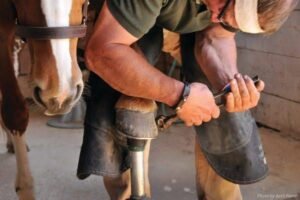
Following on from Part II of our series. A surprising majority of lamenesses involve the foot. If the problem does appear to be related to the horse’s lower limbs, feet, or hooves, a farrier may be able to diagnose the problem and provide corrective treatment. HORSEY PODIATRISTS Your farrier has an intimate knowledge of the […]

Read article
Lameness Assessment Part II: The Lameness Scale

Lameness Assessment Part II: The Lameness Scale

Following on from Part I of our series. Because each horse has individual characteristics, evaluating lameness can be challenging. Veterinarians have developed a lameness scale that ranges from one to five, with one being no perceptible lameness, and five being extremely lame: 1 = Lameness not perceptible Lameness is not observed and is not consistently […]

Read article
Lameness Part I: Owner Observation

Lameness Part I: Owner Observation

So, your horse is hopping! What can you do to address the problem and how should you go about it? It is in everyone’s best interest to take prompt action any time you have the least suspicion that something is not right with your horse, especially when it comes to any indications of lameness. Careful […]

Read article